State of Web Previews 2026: 1 in 5 Ecommerce Product Pages Lack an og:image
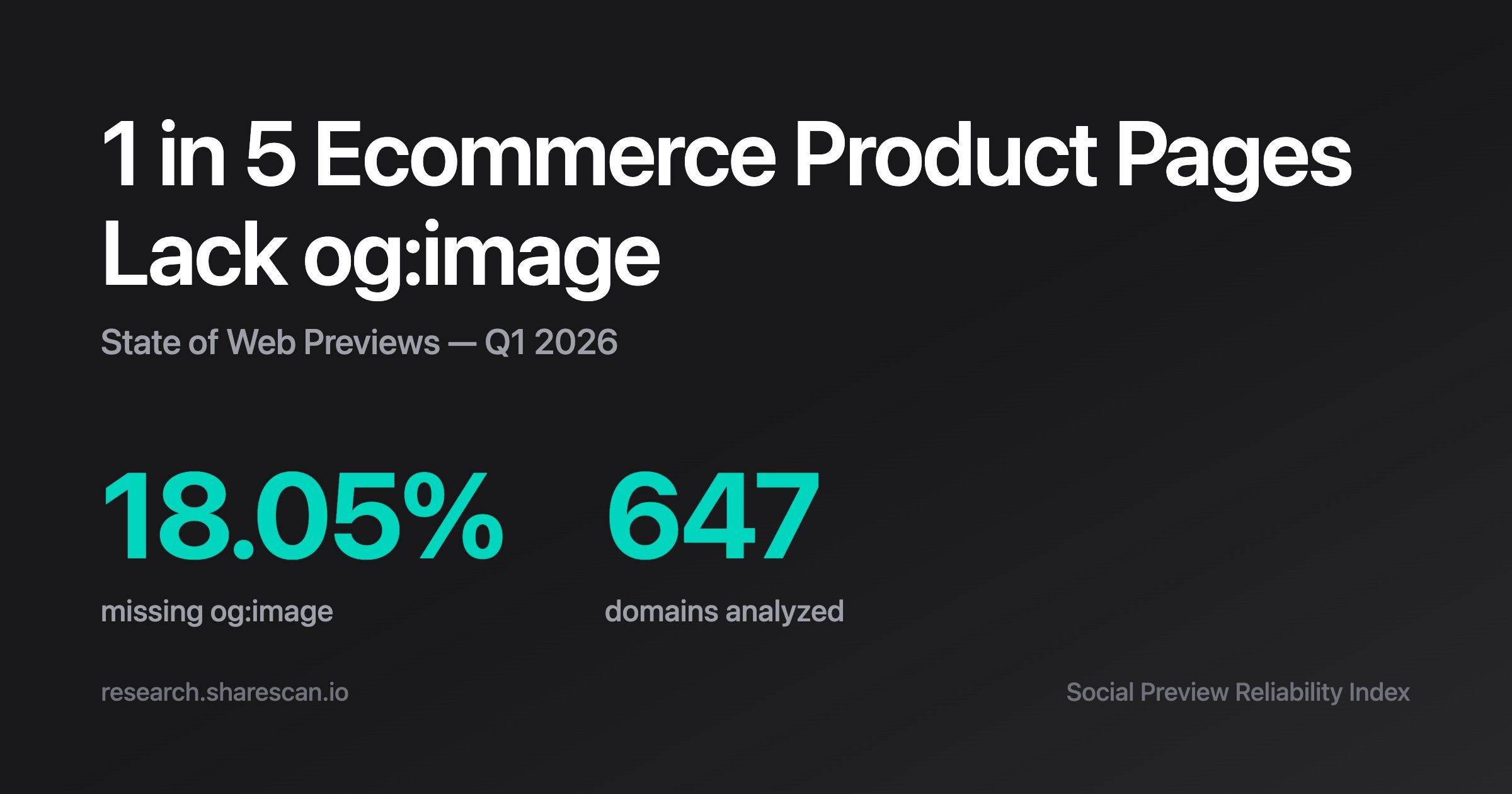
A new benchmark across 647 retail ecommerce domains shows that 27.7% exhibit structural preview risk and 18.05% of product pages lack an og:image tag.
What the Social Preview Reliability Index Measures
Social link previews influence how content is shared across Slack, LinkedIn, X, Facebook, and messaging platforms. When a URL is shared, platforms rely on Open Graph metadata — including og:title, og:description, and og:image — to render preview cards.
The Q1 2026 snapshot of the Social Preview Reliability Index analyzes 647 benchmark-eligible retail ecommerce domains, selected from the Tranco Top 200k list and evaluated using HTML-only measurement (no JavaScript execution).
27.7% of Ecommerce Domains Show Elevated Preview Risk
Across the benchmark cohort:
- 27.7% of domains score below 40
- Median preview reliability score: 79.0
Scores are calculated on a 0–100 scale and summarize structural preview reliability signals. Domains scoring below 40 exhibit elevated structural risk of broken or degraded previews.
Reliability is polarized. Many domains cluster in higher score bands (80–100), while a significant minority remain structurally fragile.
Product Page Metadata Quality
One of the clearest patterns in the dataset concerns Open Graph images.
| Classification | Share |
|---|---|
| Unreliable | 27.66% |
| Degraded | 44.70% |
| Stable | 27.63% |
Nearly 72% of product page checks show some level of degradation or structural risk.
Why Missing og:image Breaks Social Previews
When a page lacks an og:image, preview renderers fall back to heuristics or display incomplete cards. Because product pages are often generated from shared templates, missing or invalid metadata typically reflects template-level inconsistency rather than isolated errors.
A valid implementation should look like:
1<meta property="og:image" content="https://example.com/product-image.jpg" />The image URL must be publicly accessible and meet recommended preview dimensions (typically 1200×630 or larger).
Structural Fragility at the Template Level
Preview reliability issues tend to propagate through templating systems:
- Inconsistent metadata across product pages
- Incorrect canonical vs
og:urlalignment - Broken or blocked image URLs
These are governance problems, not one-off bugs.
Crawl Accessibility and Integrity
Transport-level crawl metrics were stable:
- 1.7% fetch failure rate
- 2.47% rate-limited (HTTP 429)
These metrics reflect HTML access only and do not imply user-facing downtime.
Full Snapshot and Methodology
The full Q1 2026 snapshot, including distribution charts and methodology details, is available here:
https://research.sharescan.io/
FAQ
Common causes include missing og:image tags, inaccessible image URLs, or caching behavior on social platforms.
No. All measurements are based on server-rendered HTML only.
No. The index aggregates structural patterns and does not publish ranking lists.
Continuous Monitoring
The Social Preview Reliability Index provides periodic public snapshots.
For ongoing domain-level monitoring and alerting, operational monitoring is available at:
TRY SHARESCAN
Run a free 10-URL scan on your pages
Paste a few URLs (or a domain/sitemap) and run the same metadata checks we use for social preview QA and regression monitoring.
No signup for your first scan. Open the report, review issues, then connect Slack if you want alerts.
After scan completion, connect Slack and send a test report.
Up to 10 URLs. We will dedupe and validate automatically. Prepared 0 / 10 unique URLs.